
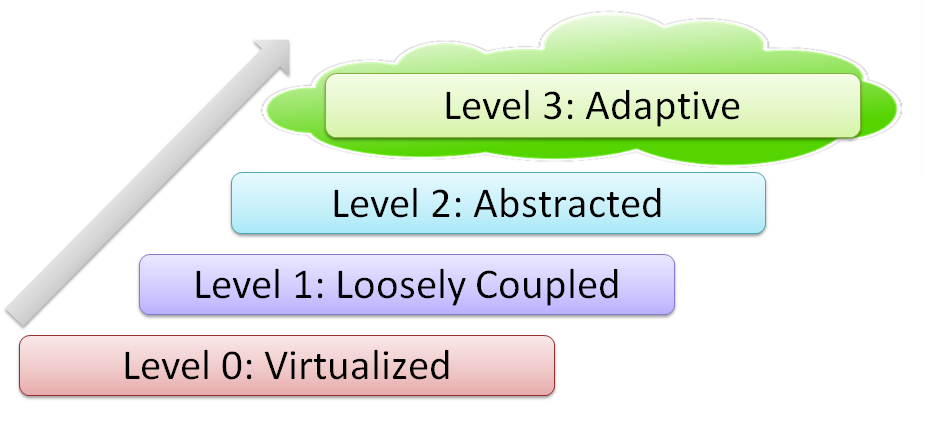
Cloud native applications are built to run optimally on cloud infrastructure. Cloud native application architectures are very different than traditional tiered applications which are designed for a data center. In this post I will discuss maturity model, from the Open Data Center Alliance (ODCA), for assessing the cloud nativeness of an application.
We are super excited to share some recent product updates. Since our beta launch, the usage and feedback has been terrific! Over the last few weeks, we have been busy adding new capabilities to Nirmata as well as addressing issues reported by our users. Here they are:
We are super excited to share some recent product updates. Since our beta launch, the usage and feedback has been terrific! Over the last few weeks, we have been busy adding new capabilities to Nirmata as well as addressing issues reported by our users. Here they are:

Over the last few years, I've spent quite a bit of time learning and discussing DevOps, as well as putting into practice DevOps principles and values. I’ve read several articles that provide detailed descriptions of what DevOps is, and what DevOps is not. Most of these talk about moving development and operations teams closer together, the cultural changes involved, etc. But none of these provided me with a simple and satisfying definition for DevOps.
Over the last few years, I've spent quite a bit of time learning and discussing DevOps, as well as putting into practice DevOps principles and values. I’ve read several articles that provide detailed descriptions of what DevOps is, and what DevOps is not. Most of these talk about moving development and operations teams closer together, the cultural changes involved, etc. But none of these provided me with a simple and satisfying definition for DevOps.
As microservices style architectures are becoming more common, new architectural patterns are emerging. Microservices style applications are highly distributed and dynamic, and a key architectural constraint for microservices applications is elasticity i.e. A microservice must be able to scale, up or down, independently of other services in the same application [1]. As a microservice scales up or down, other services need to be able to find it and communicate with its instances, resulting in requests being distributed across all instances of that service, and enabling the application to scale horizontally. There also needs to be some built in mid-tier load balancing (i.e. service-to-service) so that requests to a service get evenly distributed across its instances.
As microservices style architectures are becoming more common, new architectural patterns are emerging. Microservices style applications are highly distributed and dynamic, and a key architectural constraint for microservices applications is elasticity i.e. A microservice must be able to scale, up or down, independently of other services in the same application [1]. As a microservice scales up or down, other services need to be able to find it and communicate with its instances, resulting in requests being distributed across all instances of that service, and enabling the application to scale horizontally. There also needs to be some built in mid-tier load balancing (i.e. service-to-service) so that requests to a service get evenly distributed across its instances.

Microservices is a new software architecture and delivery paradigm, where applications are composed of several small runtime services.